
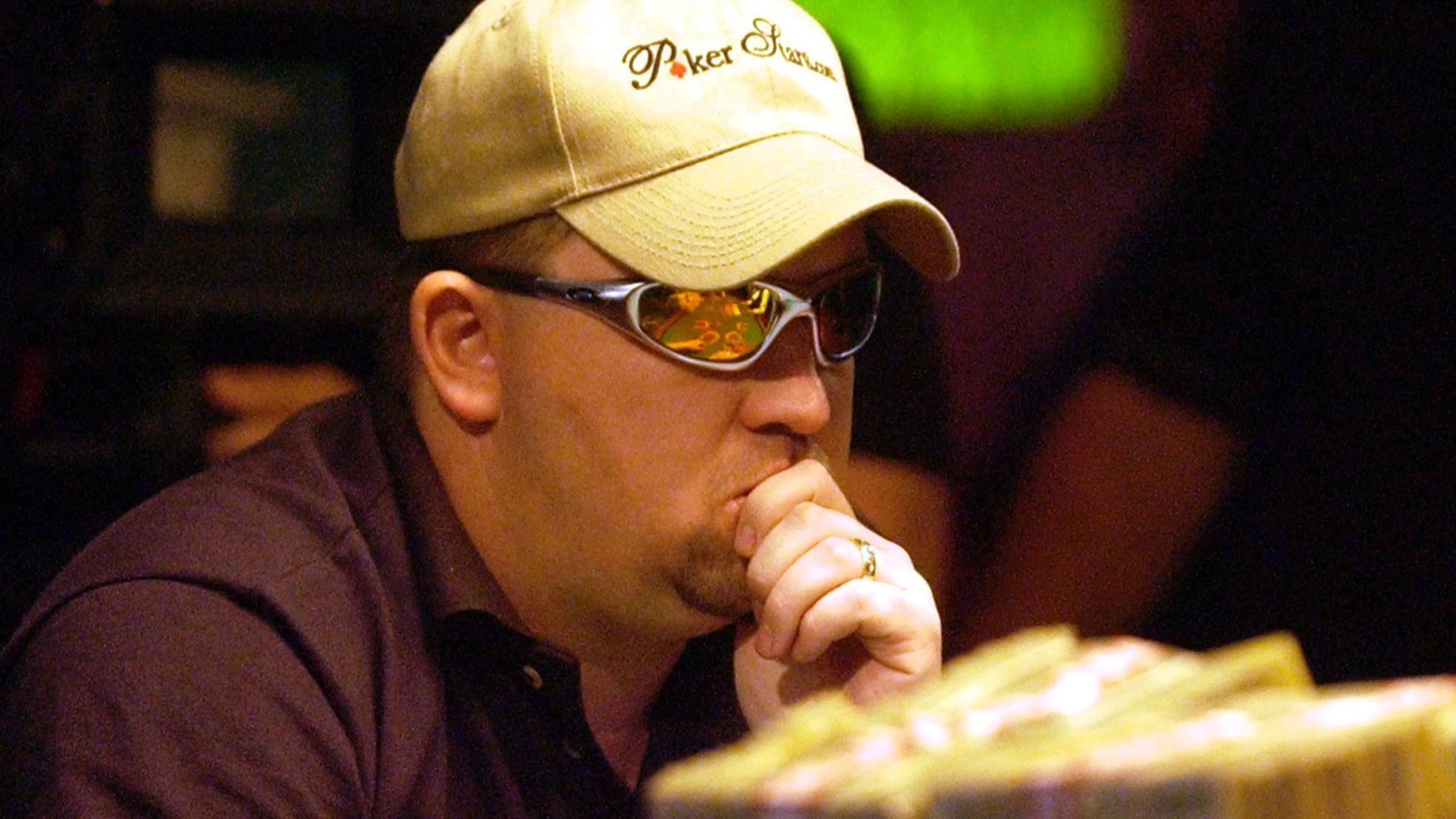
The final card was a three of hearts. It gave Chris Moneymaker nothing.
His king and seven had failed to make a straight. His four spades had failed to become a flush. Across the table, Sammy Farha held a pair of nines. If the cards were turned over, Farha would win.
Instead, Moneymaker moved all in.
They were the last two players in the 2003 World Series of Poker Main Event. A championship was within reach, and the amateur had just put Farha to a decision that could end the professional’s tournament.
For anyone who could see both hands, the answer looked obvious. Farha could see only his own.
That gap between what the audience knew and what a player could know made this one of poker’s defining moments. Moneymaker needed Farha to believe in cards he did not have. Farha needed to decide whether that story was worth risking everything he had left.
A seat won from home
Moneymaker was a Tennessee accountant who had reached Las Vegas through online poker. His qualifying journey began with an $86 PokerStars satellite, a small tournament that fed into a larger qualifier offering a seat in the $10,000 Main Event.
The leap was enormous: from playing on a home computer to entering a field of 839 players, with $2.5 million waiting for the winner.
A familiar version of the story compresses that journey into a neat transaction: $86 becomes millions. What gets lost is everything between those amounts. Winning a seat bought an opportunity. It did not buy protection from better players, bad cards, or decisions made under pressure.
By the time the field had narrowed to two, the opportunity had become something much more concrete. Moneymaker was facing Farha, an experienced high-stakes player with a bracelet already behind him.
The contrast was irresistible. One man had arrived through an online qualifier. The other looked at home in the world the newcomer was trying to enter.
The deal that did not happen
In a 2008 interview, Moneymaker recalled proposing a deal that would split the remaining prize money equally while leaving them to play for the bracelet. Farha wanted a larger share, and they continued without an agreement.
Moneymaker also described his approach to the match: put Farha in uncomfortable situations. That account matters because it gives the famous bluff a purpose beyond bravado. He was trying to create decisions whose consequences were difficult to bear.
Still, it is a retrospective explanation. It tells us how Moneymaker later described his thinking, not everything either man thought in real time.
The hand that followed would make that pressure visible.
A hand with two ways to win
Moneymaker held K♠ 7♥. Farha held Q♠ 9♥.
Moneymaker raised before the flop, and Farha called. The first three community cards came 9♠ 2♦ 6♠. Farha had top pair. Moneymaker had no pair. Both checked.
Then came the 8♠.
Moneymaker still did not have a made hand, but he now had possibilities. A five or ten could complete a straight. Another spade could complete a king-high flush. Farha’s queen of spades gave him a flush draw too, alongside his pair.
Farha bet 300,000. Moneymaker raised to 800,000. Farha called.
The raise gave Moneymaker two routes to the pot. Farha might fold immediately. If he called, a favorable last card might still give Moneymaker the winner. Poker players call that a semi-bluff: an aggressive bet backed by a hand that can improve.
But Farha stayed. The last card now had to settle whether Moneymaker’s possibilities became anything real.
| Stage | Community cards added | What changed |
|---|---|---|
| Flop | 9♠ 2♦ 6♠ | Farha made a pair of nines; Moneymaker had no pair. |
| Turn | 8♠ | Moneymaker picked up straight and flush draws; Farha also had a flush draw. |
| River | 3♥ | Neither draw arrived; Farha still held the better hand. |
Hand details are documented in the WSOP account and the interviews and analysis linked below.
Nothing left to hit
The 3♥ ended Moneymaker’s chances of improving. Farha checked.
Moneymaker could check behind and lose the showdown. Or he could bet on a different outcome: Farha surrendering a hand strong enough to beat him.
He chose the all-in.
In his later account, Moneymaker said he had intended to shove on a river that was not a spade. He believed Farha did not already have a flush and would struggle to call without a very strong hand. Then Farha identified the possibility of a missed flush draw. Moneymaker recalled concentrating on remaining still and giving away nothing.
That did not make the bluff safe. Moneymaker’s belief about what Farha would do was a judgment, not a fact. Farha could have called.
The wager depended on someone else’s uncertainty surviving long enough to produce a fold.
The professional’s problem
Farha’s pair looked excellent against the cards we know Moneymaker held. Against the hands Moneymaker might have held, it was much more fragile.
Three spades were on the board. A straight was possible. Moneymaker had raised on the turn and committed himself on the river. Calling meant deciding that an opponent willing to make that sequence of bets was bluffing often enough to justify the risk.
In a later discussion of the hand, professional player Dara O’Kearney described Farha’s pair as a bluff catcher: a hand that could beat an empty threat but lose to the strong hands represented by the bet.
Farha eventually folded.
Moneymaker won the pot with king high.
Years later, Farha pushed back on hindsight criticism in an interview with PokerNews. Watching with the cards revealed, he explained, is different from making the decision at the table.
That distinction keeps the story honest. The fold does not prove Farha was foolish. The successful bluff does not prove Moneymaker could never have been caught. It proves that, in this hand, the pressure worked.
A pot, then a championship
The bluff did not end the tournament.
Moneymaker won the title on a later hand, holding five-four against Farha’s jack-ten. He flopped two pair and finished with a full house. That was the hand that secured the bracelet and the $2.5 million prize.
The bluff supplied something different: a moment that made the result feel possible before it became final. The amateur was doing more than surviving the professional. He was making the professional react to him.
Poker was already finding new audiences through online play and television that revealed players’ hidden cards. Moneymaker’s victory gave those developments a person and a story viewers could remember.
The following year’s Main Event drew 2,576 entrants, up from 839. In 2005, it drew 5,619. Those numbers show the scale of the surge. They cannot isolate how much one player, one broadcast, or one hand caused it.
What the bluff offered was an image of agency. A newcomer could have weak cards, face a formidable opponent, and still make a consequential decision of his own.
The three of hearts had settled what Moneymaker could make. His bet left one thing unsettled: what Farha would believe.
That was enough.
Sources & Further Reading
- #10: Chris Moneymaker WSOP
- The Moneymaker Boom that almost wasn't PokerStars
- Introducing World Series of Poker Main Event Rematches WSOP
- Unlit Cigarette: Catching up with Poker Legend Sammy Farha PokerNews
- Chris Moneymaker Interview with Poker News Daily Poker News Daily
- Analyzing Moneymaker's 'Bluff of the Century' Against Farha PokerNews / The Chip Race
- Happy 10th Anniversary Mr. Moneymaker Card Player